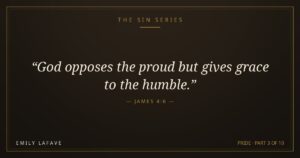
By Emily LaFave — from her series on sin, originally posted on her Facebook page.
“For all that is in the world-the desires of the flesh and the desires of the eyes and pride of life-is not from the Father but is from the world.”
– 1 John 2:16
Part 2 – Lust: something created can satisfy me
We tend to speak about lust as though it lives exclusively in the things primarily performed in bedrooms, as though it is only about sex, only about bodies, only about a particular kind of desire. That narrowing makes lust easier to condemn in others and easier to ignore in ourselves, because if lust is only about sex, then those of us who are not struggling with sexual sin can assume we are free from it. But lust is broader than that. Lust is any desire that has been allowed to become a demand, any created thing that has been asked to do what only God can do: satisfy, secure, complete, define.
Desire itself isn’t sinful. We were created with appetites, attraction, ambition, sexuality, and the capacity for pleasure. Those are gifts, not flaws. They become lust when they are asked to bear a weight they were never made to bear, when a gift is treated as a god, when a pleasure is treated as a purpose, when a desire is treated as a destiny.
I know that sales pitch well. Pornography isn’t outside my story. I started watching at 12. I’ve even monetized my own sexuality in the past, not because I was proud of it, but because I believed, at the time, that it was empowerment, that it was freedom, that it was a way to take control of something that had controlled me. I know what it is to sell what was meant to be given, to perform intimacy for an audience, to confuse attention with affection, and to believe that being desired is the same as being loved.
Lust begins to look a lot like worship from there. Worship isn’t limited to what we kneel before. We worship what we organize our lives around, what we sacrifice for, what we think about constantly, what we cannot live without. Lust organizes life around a desire, sacrifices health, relationships, integrity, and peace for it, thinks about it constantly, and treats it as indispensable. That is worship, whether it happens in a church or in a bedroom, whether it is directed at a person, a substance, a screen, or a feeling.
The freedom is in being able to observe. To experience attraction without becoming obedient to it. To notice desire without following it wherever it leads. To feel something without making it into a command. That freedom is not repression. It is not denial. It is the ability to see clearly, to choose wisely, to be governed by truth rather than by appetite.
That awareness has changed how I want to be seen as well. I don’t desire to be lusted after. I don’t want to be reduced to a body, to an image, to a fantasy. I want to be seen as a person, whole, complex, made in God’s image, with a mind, a soul, a story, and a dignity that cannot be reduced to appearance. That desire is not prudishness. It is a demand for wholeness, for being seen fully rather than partially.
I still want to be beautiful. I enjoy femininity, sensuality, and being comfortable in my own skin. Beauty is not the problem. The problem is when beauty becomes a currency, when it becomes a way to gain approval, attention, security, or worth, when it becomes something I perform for others rather than something I inhabit for myself. Beauty, rightly ordered, is a gift to be enjoyed. Beauty, disordered, becomes a god to be served.
Working against lust isn’t learning to hate desire. It’s becoming honest about what the desire is promising and whether it can deliver. It’s asking: will this satisfy, or will it only stimulate? Will this complete, or will it only distract? Will this love, or will it only use? Those questions do not kill desire. They order it. They place it back where it belongs, as a signal, not a master, as a gift, not a god.
Freedom isn’t the absence of desire. It is being able to observe it without surrendering our sight to it, without letting it define us, without letting it decide for us. It is the ability to want something and still choose what is good, what is true, what is loving, even when desire points elsewhere. That freedom is not achieved by willpower alone. It is given by grace, practiced in community, and grown over time, as we learn to trust God more than our appetites.
— Emily LaFave · Follow her writing on Facebook: https://www.facebook.com/feral.fave
Part 2 of 10.
Browse the PatchOps shop for patches, apparel, and vinyl decals.