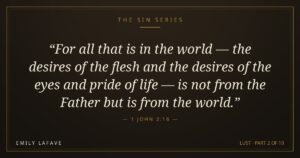
By Emily LaFave — from her series on sin, originally posted on her Facebook page.
“Take care, and be on your guard against all covetousness, for one’s life does not consist in the abundance of his possessions.” – Luke 12:15
Part 4 – Greed: What God has provided is not enough.
Greed is easy to condemn when it belongs to someone who already has more than we think they deserve. It is harder to recognize when it belongs to us, when it looks like prudence, like planning, like responsibility, like building a future, like being wise with what we have been given. Greed rarely announces itself as greed. It announces itself as wisdom, as security, as stewardship.
Money is the obvious example, but greed is not particularly loyal to money. We can hoard possessions, attention, affection, influence, opportunities, and even spiritual experiences. We can hoard anything that makes us feel secure, significant, or in control. Greed is not about the object. It is about the posture: the belief that what God has provided is not enough, and that more, in some form, will finally be enough.
The trouble with more is that it has no fixed measurement. The amount that once represented security becomes the new baseline, and the new baseline becomes inadequate. What once felt like abundance now feels like barely enough. The goal moves every time we reach it, because the goal was never a number. The goal was a feeling: the feeling of being safe, of being in control, of being enough. And feelings, pursued as goals, never stay reached.
Jesus tells a story in Luke 12 about a wealthy man whose land produced an abundant harvest. His problem was not that he had abundance. His problem was what he did with it. He built bigger barns to store it, he congratulated himself on his security, and he planned a life of ease based on what he had accumulated. He confused having resources with having control, and he confused abundance with security.
The severity of the story is difficult to miss. The man had become extraordinarily good at preparing for a future he did not control, and extraordinarily bad at recognizing the present he did not own. God called him a fool, not because he was wealthy, but because he had made wealth into a god, because he had trusted in what he had stored rather than in the God who had given it.
Stewardship and greed can perform many of the same actions. Both can save money. Both can build businesses. Both can plan for the future. Both can accumulate resources. The difference is not in the action. It is in the trust. Stewardship trusts God and uses resources as tools. Greed trusts resources and uses God as a tool, as a justification, as a blessing on accumulation.
Greed is another attempt to solve a spiritual problem with something created. Lust told me something created could satisfy me. Greed tells me something accumulated can secure me. Both are lies, because neither satisfaction nor security can be found in what is created. They can only be found in the Creator, and anything that promises otherwise is selling a version of salvation that will not hold.
Money is useful. It can feed people, build things, create opportunities, provide shelter, fund beauty, and support ministry. Money is not evil. It is a tool, and like every tool, its moral value depends on how it is used and what it is trusted to do. The problem begins when a tool becomes a trust, when a resource becomes a refuge, when a means becomes an end.
It also has a peculiar relationship with fear. We tend to imagine greed as excessive wanting, but sometimes greed is excessive fearing. Fear of not having enough, fear of losing what we have, fear of being vulnerable, fear of depending on God or on other people. Fear can make us hoard, can make us clutch, can make us build bigger barns, not because we want more, but because we are afraid of having less.
Fear can become an altar as easily as desire can. The question I keep returning to is uncomfortable: am I saving because I am stewarding, or am I saving because I am afraid? Am I building because I am called, or am I building because I am trying to secure a future that only God can secure? Am I accumulating because I am generous, or am I accumulating because I do not trust that God will provide?
There is nothing holy about financial incompetence. Poverty is not proof of righteousness, wealth is not proof of wickedness, and stewardship is not measured by the size of a bank account. It is measured by the posture of a heart: is it open, generous, trusting, and willing to release what it holds, or is it closed, fearful, clutching, and convinced that security comes from accumulation?
Greed asks us to confuse having resources with having control. Generosity interrupts that illusion. Generosity reminds us that we are stewards, not owners, that what we have has been entrusted to us, and that the purpose of entrusted resources is not to secure our future but to serve God’s purposes in the present. Generosity is not just a virtue. It is a diagnostic. It reveals what we actually trust.
The rich man built bigger barns because abundance convinced him he had finally secured his future. Generosity builds smaller barns because it trusts that God will provide what is needed, when it is needed, and that abundance is meant to be shared, not stored. The difference is not in the size of the harvest. It is in the size of the trust.
Maybe the opposite of greed isn’t having less. It is needing what we have to mean less. To build without worshipping what we build. To save without asking savings to become providence. To prepare without pretending preparation grants control. To enjoy abundance without confusing it with security.
Enough becomes possible when God, rather than accumulation, becomes the measure of what is missing.
— Emily LaFave · Follow her writing on Facebook: https://www.facebook.com/feral.fave
Part 4 of 10.